Showing posts with label teaching. Show all posts

Wednesday, 30 May 2018

Tick it off: the power of checklists.

The first time I've encountered checklists as a tool for work rather than just simple to do list or a grocery shopping list was a good few months back when I listened to a podcast with Atul Gawande. He is a surgeon and an author of The Checklist Manifesto. His ideas are in many ways so simple that I'm seriously surprised why I didn't come up with it myself. In essence, if you have a high-pressure job, to ease some of the stress and ensure you don't make silly, but high-cost mistakes, you should create a checklist of tasks that need to be complete. Simple, right?

Here's an example of a surgical safety checklist. Some of the items on that list seem so obvious. Like marking surgical area. Or confirming what sort of procedure needs to be performed. Or that test results for the correct patient are at hand.

Source: https://www.nejm.org/doi/full/10.1056/NEJMsa0810119

Now let's teleport ourselves from a surgical theatre to my classroom. It's an incredibly stressful environment. Risk of fatal injuries is pretty low on most days, but it's too easy to forget about the basics. As one class goes out of the door and another one impatiently awaits to finally get in, I have a million thoughts going through my head. Log missing homeworks, photocopy extra homework sheets for lunch, email year manager with my concern about Suzi, have I printed enough worksheets for the class this time? I need to ask Rob for his missing work from last lesson. Where is my out of lesson pass, again? I need to give out the red pens. Register! Need to get the register done in the next five minutes!

As my new class arrives, I need to park the thoughts from last lesson on focus on the children in front of me. I need to remember our routines, things to give out and messages to pass on. I need to remember what I wanted to teach them today and how to go about it. At the same time, I need to respond to anything that is going on in the classroom, this extremely unpredictable environment.

I've realised that checklists can make my life easier, freeing up an important brain space, helping me to focus on learning rather than all the little bits and pieces that need to be done while at the same time ensuring that everything is done as it needs to be, and, ultimately, making my lessons better.

I now I should use checklists more, but I incorporate them into my teaching more and more now. Here's an example:


I also have task checklist for almost every morning. When I get to school, I will sit down and write down all the task that need doing before the day starts at half eight. I'm yet to make it a prioritised list: for now it's just a checklist of sheets to print, powerpoints to finish and emails to write/respond to. It takes so much worry off my head, because I see exactly what needs doing and I am able to organise my time accordingly.

Checklists are great for students, too. When some of my classes were slipping with their exercise book presentation, I popped a list on the side of the whiteboard to remind them of the need to write down the date and title, draw a margin and write bell work questions, which in turn had to be marked in red. Last year when teaching pie charts, I devised a checklist to help students with producing the best possible quality of work. Checklists for students decrease their mental overload, since they need to remember less: they only need to refer back to the check list to see how much progress they've made already and what still needs to be done.

I'm going to use checklist more in the coming weeks and definitely next year. I want to simplify my life and make it easier, especially with all the changes coming up (you'll soon hear more about those). I feel that it can also be an amazing way of cutting down my workload: beyond not making multiple trips to the photocopier, my checklist cannot be endless, so I need to make smart choices about what needs doing. And having ticked everything essential off the list, I can leave work at a reasonable hour, knowing everything is in order.

Does having checklist kill spontaneity in lessons? Not at all! They provide structure for my work that is necessary to remain focused on what is important: on my pupils. It's a little bit like deep work: if you set time aside for producing high quality work, you will produce high quality work, because you would be free of distraction. And I think this is the biggest point of sticking to checklist: it gets your mind off the little things that are essential for the smooth running of whatever you are doing, and let's you focus on the important.

Tuesday, 17 April 2018

An introverted teacher.

Teaching does not seem like a career suited for introverted people: you spend all day talking to others, be it students, your colleagues or managers, you can't hide yourself in the office and pretend you're not there, because it's not that sort of a job.

When I started teaching, I was a little worried about this side of things. I had an office job one summer and it was really enjoyable, just sitting at my desk, getting tasks done with very little distractions. Having come to a classroom, I had to get used to high pace, unpredictability and sometimes controlled chaos. And having people around you all the time.

I don't crave human contact after work, I'm not keen on those pub outings on Friday afternoon: after a buys day, I just want to go home and finally be on my own. I will call Mr Magic and speak to my parents as well, but beyond that, I'm pretty happy to do my own thing. Every fortnight or so I might reach out to a friend to go out for a cup of coffee or to see a movie, but I'm not a sort of person who needs entertainment involving other people every night.

As it turned out, teaching is a pretty good match for my introverted personality. I reckon it's all about purposeful interactions.


If I went to a crowded party, it would make me feel uncomfortable, because these interactions would have no defined purpose. However, in a classroom, the purpose is really clear: I'm there to teach the children, and the children are there to learn. Of course, it's also about building relationships and I don't spend 100% of time talking about Maths. But this is something that I had to get used to, because I'm not naturally good at having those little chats about pets, movies, apps and whatever else children are obsessed about at that moment. So it took me some time to become comfortable with interactions going beyond strictly teacher-pupil structure. But as I got more confident and got to know my pupils better, these unstructured moments became less painful. Sometimes I'm still thrown off guard but what my pupils share with me, but I feel that I can deal with it in a much better way now than before.

Being an introverted teacher really gives me the best of both worlds. I get my dose of human contact during the day, but after work I get home to my quiet place where I can recharge. Of course, I need to manage this human contact during the day: I have quite a low noise threshold, so I struggle with loud classes and this drains me more than anything. After an hour in a particularly noisy environment I need time to recover and this might not be possible immediately, since there might be more children waiting at the door. But I can spend a break in a quiet space, or close the doors for a minute and gather my thoughts before moving on. It takes a bit of thinking and effort in terms of finding techniques which work for me, but it it necessary: otherwise the danger is that I will become emotionally burnt out.

I love my pupils and really enjoy working with them. Teaching is such a fulfilling profession and I wouldn't change it for another job. In the past two years I've found that my introverted nature doesn't hinder me at all in becoming a successful teacher. I embraced who I am and how I work, letting go of the ideas what teachers should be like or what they should do. I'm doing things my way instead, making it work for me and my pupils.


Saturday, 26 November 2016

Off sick :(

And so it finally happened. I had to phone in and say that I'd be off sick. Well, actually my housemate had to phone in, because I've lost my voice and was barely able to whisper.

I've realised that I would never actually admit to being sick enough not to go to work. I'm just that sort of a person. Mr Magic said that even if I would be throwing up I would still go in and just ask the children to hold my hair as I would still try to carry on with the lesson. I do feel like I'm letting my little ones down by not being there and not pushing through with the material. But at the same time, it won't help if I'm off sick for a week rather than just a day. 

And so I've pleased Mr Magic more than myself and had a day off.

As it stands, it's my second day of being sick, sipping lemsip (yuck!), drinking hot tea all day and trying to keep as warm as possible. I've run out of films to watch now, so I've made some progress on my colouring page, hoovered the room and organised my diary. My next low-impact project involves making a under the weather box full of supplies that help you survive a cold.


I temporarily refuse to do any work at all, partly because my brain feels like a jelly, partly because I've realised that I actually don't need to. I'm putting ridiculous number of hours into this job for five days every week, I do deserve some time off during the weekend (especially in my current state). This is probably one of the biggest eye-openers: I do enough. No need to stress out so much about lesson planning, marking etc. There is enough time during the working week. It's just a matter of prioritising.

Achoo!

Friday, 28 October 2016

Job description.

Since I’ve started teaching in September, I’ve definitely performed duties that go much beyond those written in my job description.

I’ve become a life coach and an advisor.

A house painter, a bouncer and a jester.

A crowd-controller, a multi-tasking guru and a protector.

A mediator, a sweet dispenser and a self esteem boosting machine.

I’ve mastered the skill of using all the possible setting on the photocopier and the skill of resurrecting the connection between my laptop and the smartboard.

My body has been used as a number line slider, arms of a crocodile inequality sign and other impromptu learning resources.

I’ve become an improvisation expert, a more attentive listener and a fluent conversationalist with my gut feeling.

I’ve also grown to appreciate the power of tea to carry you through a long day.

This is what being a teacher is really like. Teaching is my main job. But really there is much much more to it. And this is what I love so much about it.


Sunday, 9 October 2016

Sunday Special: More love in the classroom. That's all.

Last Sunday Bishop Philip issued a pastoral letter that was read out in every church of the Portsmouth diocese.  Putting aside my views on reading out letters instead of giving a homily for a moment, there was something else that has really made me think. 

The letter implies that it's really important to be "drawing in Catholic teacher not currently in the Catholic sector" No, no, no. What use of more Catholic teachers in Catholic schools? Pupils there already receive a good formation, they often have daily mass, reflection time, built-in prayer during the day and a chaplain at hand. Being a Catholic teacher might help you to fit in and really subscribe to the spirituality of the school, but I don't think this brings any added benefit to your young people.

Don't get me wrong, I'm a big fan of Catholic schools. But since not every school in the world is Catholic, I feel like it is increasingly important to have Catholic teachers in non-Catholic schools. Of course all teachers should be kind, understanding and committed to the wellbeing and success of their students, but those who believe in Jesus have a special responsibilities as those who have seen the Light. We shouldn't expect any less from ourselves as apostoles than making sure every child we encounter, and every member of staff, regardless of where we are placed, sees that we bring a message of love.

I don't think we need more Catholic teachers in Catholic schools. We need more love in every single classroom in the country. That's all.


Saturday, 24 September 2016

3 weeks in, still in love with the job.

It's been quite on here again! Teaching is an immense time commitment, it turns out. I might be teaching a maximum of five hours a day, but when you factor in all the planning, creating powerpoints, finding resources, printing handouts, marking and attending meetings, you get up to an almost 12 hour day.

My working days might be long and there's always more work to be done than time for it, but I love every minute of it. (I think I've said it before, but I just want to emphasise how happy I am now)

I'm so glad that I've chosen teaching over any other career. It's the best job in the world.

I've experienced a lightbulb moments with my students, seen them being extremely proud of their achievements, I was called their favourite teacher and some entrusted me with their troubles and worries.

I wouldn't change anything, except maybe adding a couple of hours to the day so I can get some more sleep. The only day when I can lie in is Saturday, and I'm trying to make the most of it.

My other relaxation involves swimming, Zumba, watching crime drama, reading about Maths (though Mr Magic disputes whether it truly counts as leisure activity), and baking. Baking is a big one, my most recent creation is an insanely good chocolate cheesecake. I think I'm spoiling my housemates a bit too much with all these baked goodies, but at least I have people to share with: otherwise my waistline would not be happy with me.


I went off to Southampton for a call back day and it was so nice to catch up with other Mathematicians doing TF and share ideas. It's amazing how many different things can be done to influence your teaching and in how many different ways I can organise my classroom, my teaching and my planning to be a better teacher for my students. I will try to incorporate some things I picked up yesterday. My most recent changes include challenge questions incorporated into slides so that my most able year 7s feel stretched enough. I also need to reconsider how I store my mini whiteboards. another teacher just taped it to the side of the tables and I might do it as well  to maximise desk space, but this requires some preparation.

It seems like I'm making a progress and everything is slowly coming together. Behaviour is improving, my planning does not take ages and students are getting more engaged. Life is good.

Found in a train toilet on the way from Portsmouth.

Saturday, 10 September 2016

Back to school.

I've survive my first week in school! Although survive might not be the best word to describe my experience, since I've actually loved every minute of it.

It was a really busy few days, filled with running around to sort my classroom out, trying to get my IT equipment to work, frantically printing out stuff for classes I forgot about, learning how to use SIMS and a thousand different little bits and pieces that I need every day to get through those few hours of the day without a major hiccup.

My classroom has undergone a little transformation: the tables are in rows rather than pods and some stuff gone up onto the display boards. I'm doing my best not to clutter the room, I know that it can be difficult to concentrate if you have a lot of stuff going on on the walls around you. So I'll try to keep it simple. I have a few quotes about mistakes around the room, I want my students to embrace making mistakes.


I've taught six lessons and met four out of five of my classes. It's amazing how much you learn on the job. I now know where the more naughty ones sit, that there are a few who try to go by without doing any work, so I need to give them a little nudge. I must say that children constantly amaze me. In my first lesson with year 7s, we had a discussion about whether there is the first (or the last) number and whether one is a prime number. Not bad for a bunch of 11 year olds. I've also taught them how the binary system works and was surprise how many of them really wanted to learn, persisting until they've understood the process. I must say that my year 7s seem to be very different from some of my year 8s who just give up when they see something unfamiliar. I really hope that I will manage to change it during this year so that they start to love the unfamiliar, embrace challenge and stretch themselves.

If I were to describe my levels of tiredness now, I would say that it's like nothing I've experience before. It's probably because I actually need to be attentive every single moment of the lesson: no drifting away, thinking about what to cook for dinner or any such thing. Just full attention for a full hour when I have the students with me. Emotional investment also comes in here. I care so much and want my students to succeed so badly, that it drains energy, especially when something goes wrong. And, my word, so many things went wrong in the last couple of days. I had to send pupils out of my classroom, stop the entire lesson to have a serious chat about attitude to work and I've almost lost my voice trying to be heard over their chatter. 


It definitely feels like a learning curve, but I know it will be absolutely amazing. There is no better way to spend your time than to educate young minds.


Wednesday, 27 July 2016

Pseudo-science of teaching.

Teaching is full of myths and misconceptions. Why is that so? I suppose that teachers are desperate to explore new strategies that might work for their students and improve their learning. Any good-sounding ideas seem to get adopted by schools. There also does not seem to be the same sort of rigour with evidence as it happens in medicine for example.

And thus the myths proliferated and multiply as the time goes. Some might think that these are wholly innocent. But what effectively happens is that precious time is taken away from learners. Spending your energy on chasing the newest fad in education instead of concentrating on teaching is never productive. This is why it is so crucial why it is so important to distinguish science from pseudo-science in teaching. The demand on teachers' time makes is really hard to reconcile with doing proper research into what techniques have a proper scientific grounding. This is why blogs such as Evidence into Practice are so helpful. There are also many books and articles which are freely available that can extend your knowledge. I believe it is absolutely necessary to dedicate some time to become a more informed practitioner.

Here are a few common myths:

1. Learning styles: visual, auditory, kinaesthetic (VAK), we all heard it. This is simply not  thing. There is no scientific basis for this theory. Daniel Willingham explains this really well in the video below. So instead of adjusting the way of delivery to the supposed "style" of the pupil, present the material in the most appropriate mode.

2. We remember only 5% of a lecture, 10% of what we read, 20% of what we see and hear and 75% of what we do: which supposedly means that the most effective way of teaching is experiential. This is often presented as a pyramid like the one below:
source: washingtonpost.com

Lots of nonsense. As Lalley and Miller (2007) point out in The Learning Pyramid: Does it point teachers in the right direction?:
The research reviewed here demonstrates that use of each of the methods identified by the pyramid resulted in retention, with none being consistently superior to the others and all being effective in certain contexts. A paramount concern, given conventional wisdom and the research cited, is the effectiveness and importance of reading and direct instruction, which in many ways are undermined by their positions on the pyramid. Reading is not only an effective teaching/learning method, it is also the main foundation for becoming a “life-long learner”.”
 Very good article debunking this myth can be found here.

3. Brain gym: I'm not sure where to start with this one, really. If you haven't heard of this one yet, brain gym is  a set of movement activities such as "crawling, drawing, tracing symbols in the air, yawning, and drinking water" (Hyatt, 2007)One of the organisations providing brain gym training claims that it can influence and improve:
  • Concentration and Focus
  • Memory
  • Academics: reading, writing, math, test taking
  • Physical coordination
  • Relationships
  • Self-responsibility
  • Organization skills
  • Attitude
Miracle cure to all the problems, isn't it? We should be surprised that we are not all going around rubbing our stomachs and patting our heads. Yet there is no scientific evidence of any of the claimed benefits. Of course, physical exercise is a healthy habit and we should encourage children to get active, but making them do ridiculous manoeuvers with their body is not a good idea. A little bit of exercises in the middle of a Wednesday afternoon lesson to wake everyone up- yes; brain gym - absolutely not.

Wanting to improve your practice is absolutely crucial both for your professional development and, more importantly, for the improvement of pupil progress. But we need to be weary of fancy fads. Sometimes the simplest ideas are the best. And whatever you try, always think: does it make any sense? Is there any evidence behind it?

Thursday, 21 July 2016

Crazy stuff and long days.

Training to become a teacher involves a lot of fun activities. Such as researching squeaky puppets. And fun facts about pi. Making posters for my classroom. Planning classroom layout. Role playing a naughty child (this I'm doing all too well). Lying on the floor and humming. Presenting crazy lesson plan to the group. Making flamingos out of multilink cubes. Watching ridiculous videos on youtube (I highly recommend the one below, it's hilarious). Making paper tutus. Drawing gigantic circles on the pavement.


There are also not so much fun parts of my life now. Like waking up at 6am. Or having classes and workshops starting at 9am and going on until 7pm (or even 9pm). The paperwork which never ends. And piles and piles of important pieces of paper scattered around. Long post-lunch lectures. Wearing business clothing every day. 68 pages of Maths exercises.


The former definitely outweigh the latter. I'm having a fantastic time, this time in Leeds and I simply cannot wait for when I go into the classroom in September. I've learnt so much in the past weeks, it's incredible how much you can absorb. I now have a folder full of resources, tips, practical ideas and suggestions. I'm pretty sure that my first lessons will be disastrous, because you only gain confidence with experience, but at least I have an armoury of things to try out. I'm actually becoming progressively less worried about teaching. And I'm finally getting on the top of things I need to do (slowly, yet steadily).

There's only one more week left now and then a well-deserved break! Though planning will inevitably happen as well: I need to organise myself, create all my posters and such, but it will be a fun part. In the meantime, there's TF Impact Conference on Monday and Tuesday! There are a lot of interesting sessions, I'm in the process of compiling a stack of post-it notes with all the talks I want to go to, it's almost impossible to make a choice. I definitely want to hear about engaging parents- it's something really close to my heart since I've written an essay on it. There are also some sessions on motivation and leadership that I will try to get into. I really hope these will be useful and set me up for September.

-------------------


On a different note, Leeds is absolutely boiling this week. It's barely impossible to cope with the heat. Thankfully most of our lecture theatres and classrooms have air conditioning, so at least during working hours it's a little bit more bearable. I suppose it's nice that after two months of temperatures in the region of 10 degrees and rain it's nice to have some proper summer, but, gosh, I'm glad I live in a country well such weather is not that common.

Friday, 24 June 2016

First visit to the Isle of Wight.

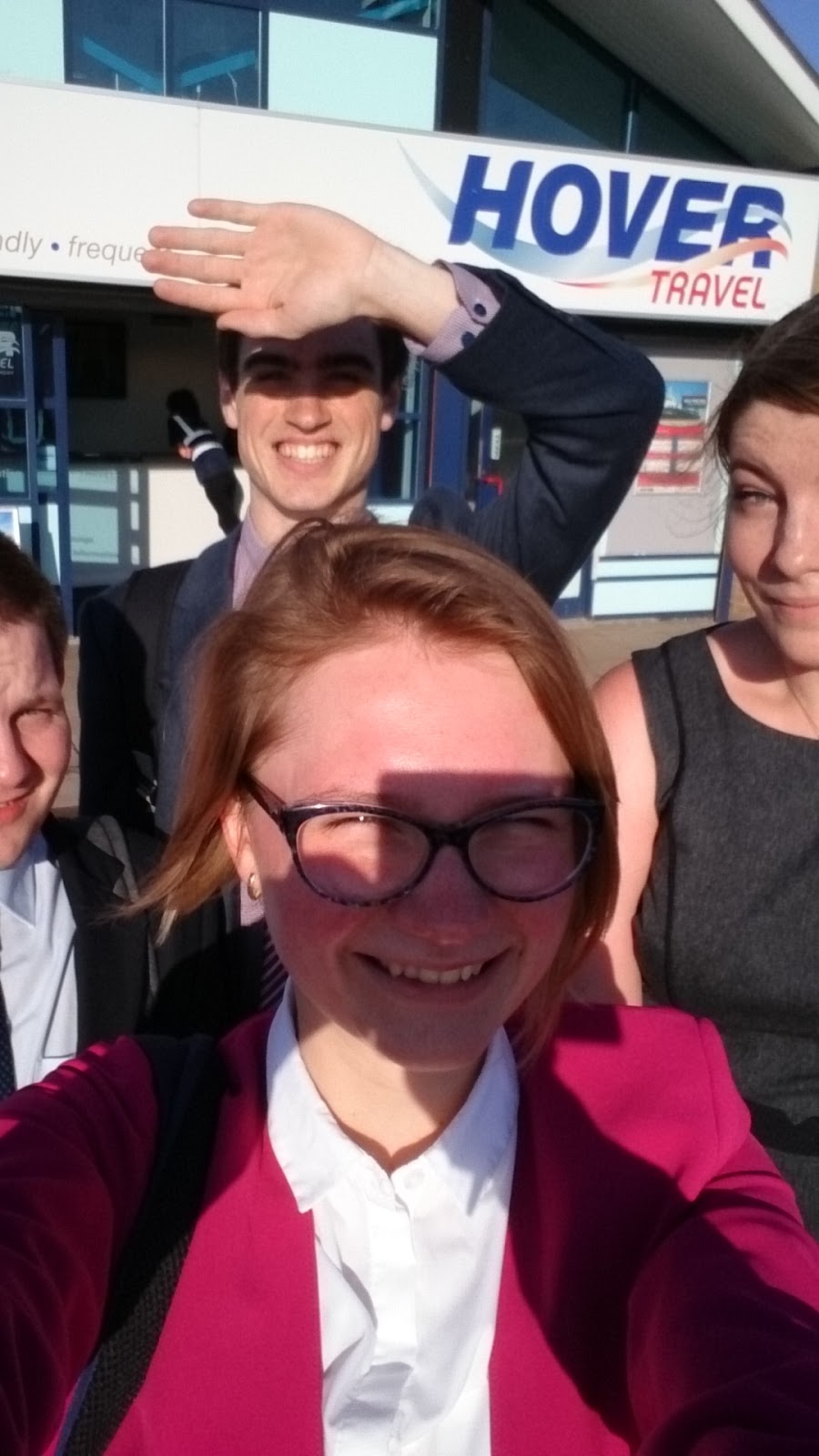
5:50am start. And I'm not joking. This is how early I had to wake up in order to catch a 7:30am hovercraft to Ryde.

Though this very early morning was definitely compensated by the exiting things happening all throughout the day. We've been blessed with great weather and some very exciting stuff going on all through the day.

First, it's been quite an experience to be on the hover. I would compare it to an aeroplane. It's a bit bumpy, but 10 minutes of the journey flied by and before we knew it, we were on the island! For my very first time.


Second adventure of the day was the trip on the Island Line train. Well, it's really two old underground coaches. Traveling on it feels like a ride on a rollercoaster. It's brilliant and the views of the countryside are beautiful. I quite like the perspective of taking it every day for the next two years.


And I've finally visited the school where I will be teaching and it's fantastic! The facilities are great, the staff is friendly and helpful and apparently the children are very amicable too. So I believe I will have a fantastic time there. We've been taken for a drive round the local area to get to know it better by two lovely local councillors. Now I know where the best playground is, know the story of most of the derelict buildings round there and I know where the most beautiful beach on the island is.

I'm due to meet my Maths mentor on Monday and I'm really excited about that. I really want to get my hands dirty and get some serious work done. I need to learn so much, from simple practical stuff about where the loos are, through the layout of lesson plans, schemes of work, behaviour policy, to departmental meeting times and so on. It will be a great two years. Or maybe more. I can see myself staying on the Isle, it's so beautiful and just already feels like home.

In the afternoon I've visited Shanklin and I've absolutely fell in love with it. It's small enough to be cosy, but at the same time there are plenty of shops and cafes, the beach is just round the corner and apparently there is a charming old town here as well. I have a lot of exploring still to do, yet to visit the beach, but I've found a nice cafe for a morning coffee on Saturday and I now know my way round the centre of the town. I can imagine myself living there. Definitely a serious contender.


I'm really happy after today's trip. It just feels like a dream come true really. Maybe living on the Isle of Wight is a bit crazy, but, well, life needs to be crazy sometimes. Tomorrow is another day of exploring the island. I'm loving my life.

Wednesday, 22 June 2016

First few days in Portsmouth - #TFSI2016

I've realised that maybe not everyone is clear about what Teach First does and what Summer Institute is and since this will definitely dominate the next six weeks of my life (and be a big part of the next two years), I thought it would be helpful to write a few words about it before I update you on what actually has been going on across the last few days.

Teach First is an organisation which works towards a vision that no child's educational success should be limited by their socio-economic background. There is still a long way to go in that respect. UK is a country where the gap in educational achievement between pupils from more affluent families and those from less well-off families is greatest in the developed world. TF is driven by five values: collaboration, commitment, excellence, integrity and leadership. These guide everything that people involved in TF do. Summer Institute, on the other hand, is an intense, six-weeks programme which is designed to prepare new Teach First participants for their teaching role. It includes talks, lectures and workshops. I won't lie, it is demanding. We need to cover a wide range of topics in a very short space of time. No time to waffle. But it is also hugely enjoyable, because you feel like you are learning every minute and what you learn will be really helpful in your practice.

------

Since I've arrived in Portsmouth four days ago, I've been bombarded with information about what to expect during the Summer Institute, what is expected of me as a teacher, what teaching techniques I might want to employ, the assignments I will need to write to get a PGCE, standards, policies, the importance of reflection and the community. The days are really long and full on, 9am until almost 6 pm, but I'm really enjoying it.

And the people are fantastic. Really optimistic, passionate about education and young people, willing to go an extra mile to address this pressing issue of educational disadvantage. I think we will form strong friendships during this programme. Because it will be tough. But I'm up for it.

Today we visited a school to observe some outstanding practice. It is such a weird feeling to observe in practice some of the techniques we were taught about. I've made extended notes on what teachers say, how they behave, how they move about the classroom and how they make sure that pupils stay focused on the task in front of them. There was also a student panel where we had an opportunity to ask pupils some questions about teaching and learning, their life outside the school and what they make of Portsmouth. It was really interesting to hear directly from them. And interestingly we had some pupils who loved Maths in that group and some which absolutely hated it. From my point of view it is interesting to explore why there is this dramatic difference in order to try to bridge the gap in engagement in my classroom.

------

Next week will be particularly exciting, because I'll be visiting my new school on the Isle of Wight! I will meet my new colleagues, my potential pupils, all the staff, will find out how exactly the school is run and how they expect me to work. I really can't wait for it, I'm really really looking forward to it. And the teachers I've already spoken to are really excited about having the four of us (Maths, Science, RS and English) at their school. Apparently there are two, potentially three other trainee teachers coming to the school in September as well, which should be fantastic, we will have a little community of newbies.

Famous hovercraft. Quite a sight live.

Enough for now, need to get ready for another long day. Ahoj!

Monday, 13 June 2016

How to be a great teacher?

I sometimes worry whether I can be a great teacher. I'm rather shy and not always confident. But apparently I don't need to have an expressive personality to change pupils' lives (see the video below). I need to remind myself, that I have to have faith in the Teach First assessment process. They've chosen me for a reason. And I can make a difference to the young minds I meet in my classroom. Thankfully, it appears that you don't need to behave like a celebrity to win the hearts of your pupils and help them to learn effectively. You need to work hard and keep and open mind, always willing to change your plans and adapt to the needs of the children. 

And a certain amount of acting skills is also required. This is actually my favourite part. You stand in front of the classroom and you're not Kat anymore. You're Miss Z, and Miss Z is whomever you decide her to be. She can be funny, she can be strict, she can be demanding, she can be bouncing, whatever I want to do in the moment. And it is fantastic to be able to do that.


Apparently parents prefer their children to be taught by "qualified" teachers (see here). I won't be qualified when I start in September, as a matter of fact I haven't even studied Maths at university. But I hope I can make up for that by my enthusiasm and continual development of my subject knowledge and my caring nature. 

One looks back with appreciation to the brilliant teachers, but with gratitude to those who touched our human feelings. The curriculum is so much necessary raw material, but warmth is the vital element for the growing plant and for the soul of the child. --- Carl Jung

There is a lot of things I hope to incorporate into my teaching. I really like the idea of checks for understanding which are visual, although it might be easier to employ them with younger years. I will definitely set high goals. I'm not a fan of ability setting and would rather teach mixed groups, but you need to play with what you've got, so I will just expect a maximum effort from all of my students, regardless whether they have been labelled as low-ability or high-ability.

I want to be a great teacher. Not because of my own personal ambition. But for the sake of the children. I want them to have a good start in life. I won't be perfect, probably some of the time I will have no idea what I'm doing, but I will do my best, will always try. 

A good teacher is a determined person. --- Gilbert Highet