Showing posts with label organising. Show all posts

Saturday, 3 November 2018

Juggling a Master's and a full-time job.

What a lovely way to spend a Saturday. Grocery shopping, putting together an IKEA storage system and spending hours reading educational journals.

Doing a masters degree is a challenge. Doing it while working full time is even more challenging.

I've done my PGCE while working, but it was very different: I didn't have a full teaching timetable at the time and my life was much less demanding in general. I've started my two-year part time course last year and I can already say that this year is much more challenging. I work more hours this year and I have very limited time that I can actually commit to focused for on my thesis.

By next September, I have to have my thesis completed regardless of work circumstances, however, so I had to quickly find ways of making it work. Part of it is simple organisation, part of it letting go of my ideas what studying should look like.

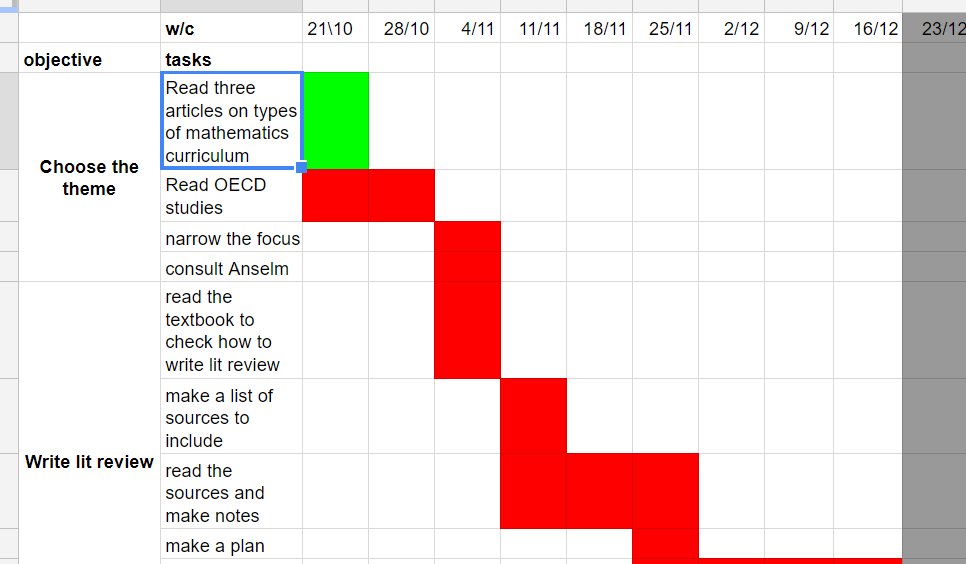
And so I've created a schedule. I love planning, so it was was an easy task for me. The key is to be both realistic and specific about what needs to be done. By Christmas, I should have my literature review ready (ha ha ha), but it is not a specific enough goal to have. So I broke it down into manageable weekly tasks: reading specific articles, books, calling my supervisor etc. It is not a perfect schedule and will evolve with time, but it gives me some structure to begin with.


Now I've also created a home office in the spare bedroom so that I have space dedicated exclusively to working, be it school work or MA work. I don't have a massive need to have a special room for work, I live on my own so I don't have many distractions here (bar a cupboard full of delicious tea and chocolate), but sitting in my little office puts me in the work mindset straight away.

Finally, I had to accept that whole day study sessions are not likely to happen this year. I might manage to spend a couple of days over half terms working on the thesis, but on the whole, it will be just using these little pockets of time here and there. I need to find my own rhythm. I usually have a little bit of time in the evening between dinner time and relaxation, so I use that time to read an article or think about my ideas (I sit around thinking a lot. And talking to myself). But this is probably my biggest struggle at the moment. I'm used to long stretches of time dedicated to studying or writing and I don't get many of those now. But the only way to do it is to make it work.

I must say I have a love-hate relationship with this Masters programme: it's yet another thing that I need to do think about and schedule into the week, but at the same time I really enjoy reading articles and learning about new perspectives on the Mathematics curriculum. I know that this is probably the best time to do it, before my careers becomes even more demanding and before I become a mother; and I will benefit immensely from it in terms of my professional and personal development. But for all of you out there thinking about studying part time and working full time at the same time: it's not  piece of cake. But you can do it with plenty of cake at hand.

Enough, back to juggling now. :)

Tuesday, 10 July 2018

Prepping for the Move: The kitchen.

I will be moving in a couple of weeks so I really need to try to declutter as much as I can as early as I can so that when it comes to the move itself, I can just pack up what I need rather than spend that little amount of time I will have thinking if I really need certain items. I have already shared my wardrobe declutter some time ago (I will definitely need round two of that) and now I'm sorting out my kitchen.

I will have more storage space in the new kitchen, but I really don't want to clutter it up with stuff I don't use. And so I've started a process of working out what I needed and what I could live without. Some things I had in my cupboards and decided to let them go. Some I've considered buying for a long time, but now I'm set on not getting any more stuff unless I can justify it properly. I have a plan for that kitchen so everything needs to fit into the designated cupboards. Here's my kitchen master plan:


And now for the kitchen declutter.

Appliances
Blender: I'm still considering buying a proper high powered blender, because I would like to make my own hummus and such stuff rather than keep buying ready made products from the store, but it's an investment of around £400, so I put that one on hold for now. I used to have a standing blender with three different types of attachments, but it was too bulky and took so much space while being rarely used that I've decided to sell it. I have an electric whisk for when I make cakes and a hand blender for making soup in winter. 

Waffle maker/panini press etc: I have to confess I used to be so into such stuff. Isn't that cute to make waffles on Sunday morning? But in reality, this is not what I do, so these sort of things needed to go, and fast.

Utensils
Knife set: Really, who needs 10 different knife types? I have four different knifes with different blade types and lengths, I might reduce the number to three actually, thinking about it now. That's sufficient for all my needs.

Single use tools: Egg separator/ poached egg maker, citrus press, egg slicer, apple corer, little nutmeg grater, pizza cutter. Generally anything that relates to egg preparation is largely redundant. You literally need two hands to separate the yolk from the white. All of the other items are also easily replaceable with more versatile kitchen utensils. My parents have (multiple) pizza cutters. I literally see no point in that: I cut pizza into slices using my regular kitchen knife, I find it much easier. As a rule of thumb, if you can do it with a knife, use a knife. And if you can use your hands, use your hands. 

Rolling pin is another one. Many a time I thought of buying one, you can get these cute thin wooden ones or those proper old school rolling pins with ceramic surface, but in all honesty, I've always used a wine bottle to roll out the pastry.

Multiples
I do need more than one set of cutlery, more than one plate and a mug, but do I really need five different wooden spatulas in addition to a turner and a skimmer? In short, no I don't. I rarely need two spatulas/spoons at a time. Also those wooden slotted spoons are impossible to clean properly.


I've also got rid of multiple chopping boards. I have a glass board, a plastic board and a smaller wooden board. The first one functions more as a surface protector than anything, the other one I use for chopping veggies etc, the last one is for bread. Simple. I suppose not eating meat helps, because I don't need yet another board for that purpose.

Random stuff
Coffee/tea mugs that are mismatched or you don't love + wine glasses and other glasses: I have gin glasses, and 5 wine glasses out of a set of 6 (no clue what happened to the 6th one). The thing is, I don't really drink at home, I don't really drink that much at all really, so I don't think there is much point in keeping so many of those. I have actually purchased a set of four glasses that can serve all the purposes of all the other glasses I had, so that I have less things in my kitchen.

I'm not even near tackling all the foods in my cupboards yet. It will be a massive task. I have a lot of food. I mean it. But that's for another time.

Wednesday, 30 May 2018

Tick it off: the power of checklists.

The first time I've encountered checklists as a tool for work rather than just simple to do list or a grocery shopping list was a good few months back when I listened to a podcast with Atul Gawande. He is a surgeon and an author of The Checklist Manifesto. His ideas are in many ways so simple that I'm seriously surprised why I didn't come up with it myself. In essence, if you have a high-pressure job, to ease some of the stress and ensure you don't make silly, but high-cost mistakes, you should create a checklist of tasks that need to be complete. Simple, right?

Here's an example of a surgical safety checklist. Some of the items on that list seem so obvious. Like marking surgical area. Or confirming what sort of procedure needs to be performed. Or that test results for the correct patient are at hand.

Source: https://www.nejm.org/doi/full/10.1056/NEJMsa0810119

Now let's teleport ourselves from a surgical theatre to my classroom. It's an incredibly stressful environment. Risk of fatal injuries is pretty low on most days, but it's too easy to forget about the basics. As one class goes out of the door and another one impatiently awaits to finally get in, I have a million thoughts going through my head. Log missing homeworks, photocopy extra homework sheets for lunch, email year manager with my concern about Suzi, have I printed enough worksheets for the class this time? I need to ask Rob for his missing work from last lesson. Where is my out of lesson pass, again? I need to give out the red pens. Register! Need to get the register done in the next five minutes!

As my new class arrives, I need to park the thoughts from last lesson on focus on the children in front of me. I need to remember our routines, things to give out and messages to pass on. I need to remember what I wanted to teach them today and how to go about it. At the same time, I need to respond to anything that is going on in the classroom, this extremely unpredictable environment.

I've realised that checklists can make my life easier, freeing up an important brain space, helping me to focus on learning rather than all the little bits and pieces that need to be done while at the same time ensuring that everything is done as it needs to be, and, ultimately, making my lessons better.

I now I should use checklists more, but I incorporate them into my teaching more and more now. Here's an example:


I also have task checklist for almost every morning. When I get to school, I will sit down and write down all the task that need doing before the day starts at half eight. I'm yet to make it a prioritised list: for now it's just a checklist of sheets to print, powerpoints to finish and emails to write/respond to. It takes so much worry off my head, because I see exactly what needs doing and I am able to organise my time accordingly.

Checklists are great for students, too. When some of my classes were slipping with their exercise book presentation, I popped a list on the side of the whiteboard to remind them of the need to write down the date and title, draw a margin and write bell work questions, which in turn had to be marked in red. Last year when teaching pie charts, I devised a checklist to help students with producing the best possible quality of work. Checklists for students decrease their mental overload, since they need to remember less: they only need to refer back to the check list to see how much progress they've made already and what still needs to be done.

I'm going to use checklist more in the coming weeks and definitely next year. I want to simplify my life and make it easier, especially with all the changes coming up (you'll soon hear more about those). I feel that it can also be an amazing way of cutting down my workload: beyond not making multiple trips to the photocopier, my checklist cannot be endless, so I need to make smart choices about what needs doing. And having ticked everything essential off the list, I can leave work at a reasonable hour, knowing everything is in order.

Does having checklist kill spontaneity in lessons? Not at all! They provide structure for my work that is necessary to remain focused on what is important: on my pupils. It's a little bit like deep work: if you set time aside for producing high quality work, you will produce high quality work, because you would be free of distraction. And I think this is the biggest point of sticking to checklist: it gets your mind off the little things that are essential for the smooth running of whatever you are doing, and let's you focus on the important.

Tuesday, 22 May 2018

Keeping organised.

If you know me personally, you probably know that I absolutely adore organising in the most extensive sense of the word. I will organise everything in my life, from food to eat in a given week, through groceries that need buying, my wardrobe, paperwork, kitchen cupboards, to sorting out travel arrangements and coming up with trip itineraries. If I ever feel like I don't want to teach anymore, I will probably become a PA or wedding organiser, this the extend to which I love organising.

Some people want to go with the flow and be spontaneous all the time. This is not the way I function and, honestly, just thinking about not having even the most basic plan for the next 24 hours (and the next week, and next month) fills me with dread. Also, I need to write things down because otherwise the sheer volume of stuff I need to get done is overwhelming when it is left in my head. Get it down on paper. Free up your headspace.


I know that there is a plethora of apps available these days to help you get organised. You have calendar apps where you can put appointments, reminders, regular events, birthdays etc. You have list apps for, well, creating lists: to do lists, shopping lists, ideas lists. There are meal planning apps, exercise scheduling and tracking apps, you name it, there is probably an app for that.

However, I'm not a fan of apps. The thing is, if I need to use my phone too often to input all these bits and pieces to make the apps work for me, I will inevitably start browsing through my photo album, watch different videos on youtube and before I know it, an hour would have passed. 

So I use a paper planner to organise my life. The one I am using this year is actually The Catholic Planner that Mr Magic has kindly got for me from the US and it has all the bits I need to organise my spiritual life, but also is great for organising the other parts of my life.

It might be controversial, but I actually invest quite a bit of time into making my planner pretty and colourful, I colour-coded different events, got colourful stickers (yep, I did, no shame) and I use different coloured pens to jot down certain things. Some people don't like that and they think it's a waste of time, because you really only need to have a list of things to do and appointments to keep, but I actually don't do so much creative stuff in my life and also, I like the fact that a quick glance at a page is enough for me to know that there is a meeting that I should get to tomorrow (orange highlighting) or that there is some rather urgent house admin to get on with (Christmas green I call it). It's also really relaxing and I do most of my intense planner work on Sundays when I don't work and have plenty of time. Long story short, it works for me.

I have two levels of planning, a monthly overview and a more detailed weekly plan. The monthly overview is really there to stop me double booking weekends: I often have my Master's sessions on Saturday, or maybe conferences and this part of my diary is just to make sure that I don't promise somebody to do something or meet with them on that day.


The weekly view is really where most of the action happens. I don't plan my day to the minute, but I will write down any appointment and meeting times, including those regular ones like church on Sunday or an exercise class on Thursday. This helps me to organise other activities around those if I need to. I jot down things that need doing at a particular time or on a particular day. I also often write down a quick meal plan, i.e. what's for dinner and lunch during the week so I don't have to make those decisions when work is busy.


Keeping organised gives me a sort of safety net when life is hectic and unpredictable. It is both a necessity and a pleasure for me. I don't think I would be able to function without organising and making appointments, drawing lists, ticking things off... And I get so much fun out of it as well. I suppose some people crochet, some jog and I just make my planner look fabulous. That's just the way it is.

Tuesday, 6 March 2018

Managing my wardrobe.

I've decided to do a proper house clear out this year, partly because I will be moving and it's a daunting prospect that all the stuff I currently have at home needs to be taken elsewhere (there's just too much of it), partly because I've become interested in minimalism and owing less.

I've started with paperwork and in one evening I've got rid of two folders full of old notes, printouts, advertisements and who knows what else. This was an easy fix, though I still want to digitalise most of the paper documents I have lying around.

My bookcase also got hit with the clearing out madness and many books which I have already read and would not read again, or those which I've started reading but never finished got sold or given away. I love books, but I have so many, and I spend insane amount of money on books each year that I've resolved to use the local library more.

Now the time has come to tackle my wardrobe.

This was my pile of clothes after I've emptied the wardrobe and suitcases. Loads and loads of stuff.  Dresses, jumpers, trousers, tops, skirts... The good thing is, I actually remembered that I had every single item here. So no surprises when the contents of my wardrobe was sifted through.


To aid sorting, some organisation was necessary I've made piles of types of clothing: this seemed like the only system that will work and will give me an overview of what I really have.


Now, I didn't think I had loads of stuff, I actually pretty regularly donate unwanted clothes to charity, but after I've counted all the clothing items that I had, I was rather shocked. This is when all the surprises came. This is my list:


13 pairs of bottoms?! I don't even like wearing trousers! Also, 19 dresses, I knew I had loads, but didn't quite realise that it was so MANY. It's insane! And the thing is, very few of those items were actually weather-specific. Apart from winter coats (yep, multiple >.<), the vast majority of my clothes can be worn all year round, with the exception of some summer dresses and such, so why do I need so much?!

Making this list of all the things that I possess made me quite uncomfortable. I don't need 3 different hoodies. I really don't, I barely ever wear sportswear. I don't need all 19 dresses. Or 17 tops! Oh my... And this is AFTER I've done some wardrobe decluttering already. I seriously got rid of so much stuff already. Insane.

I have managed to downsize massively now, although I still have a bunch of things that I'm not sure about. Those occasion dresses have been listed online, little bits and pieces taken to charity shops. I've realised that I have a lot of bold pieces but not so many neutral staple pieces that could be easily mixed and matched. This will eventually become my focused, to build a more functional collection of clothes.


Here's my wardrobe now, minus a shirt, a dress and a couple of tops. Most categories of items on my list have been halved in quantity.

For the time being, I'm testing whether the items that I've decided to keep are actually items that I wear regularly. I put all the hangers backwards and they only get turned around when I wear that item. Hopefully after a few months all the hangers will be turned around. But if not, then I will need to reconsider certain pieces.

I would recommend to do a wardrobe purge to everyone. It really does make you re-evaluate your possessions. Do I want to have loads of clothes of often poor quality or do I want fewer clothes that will last? Do I want to spend loads of time trying to work out what to wear or do I want to have a set of outfits that I can rely on?

I think now it's a nice to do it as well, because the winter season is coming to the end so you can go through your warm clothes and declutter those which you didn't wear at all. And you can go through your spring/summer outfits and really ask yourself: do I want to wear this in the next few months? This will only take a couple of hours in the afternoon. Listen to a good podcast while you're doing it (I really recommend Hidden Brain on NPR). And afterwards, treat yourself to a good cup of coffee and a hot cross bun or whatever else you fancy.